
Articles | October 22, 2026
Investment risk is one of the largest and most critical issues for pension plan sponsors. To reduce that risk, pension plan sponsors should consider evaluating whether to implement a de-risking strategy that takes advantage of today’s relatively high interest rates.
Over the past few years of high interest rates, some sponsors have successfully de-risked their pension plans.

In this article we:
It is tempting to equate “de-risking” a pension plan with reducing the standard deviation of the investment portfolio. In fact, quite often, these two concepts are not the same thing.
The real objective of de-risking a pension plan is to maximize the chance that the plan will meet its long-term funding objectives while minimizing downside outcomes.
For example, intuition may push for reducing the portfolio’s expected annual investment volatility, which usually means a lower expected return. This strategy can help stabilize funded percentages and contribution requirements year to year.
Some plans will find, however, that maintaining a higher expected return target will make it more likely that the plan will achieve its long-term funding objectives. At the same time, cash-flow matching can help minimize the chance of a severely negative short-term outcome.
The first step in de-risking is for the plan sponsor to define its funding objectives. For example, a well-funded multiemployer plan (in the green zone) likely wishes to stay there. Future benefit improvements may be desirable. And of course, any board of trustees would want to avoid a scenario in which the plan is projected to become insolvent and fail to make promised benefits.
As we highlighted in “Benefits of Pension De‑Risking and Why Now Is the Right Time,” an article we wrote in 2024, “mature” pension plans usually have negative cash flows, because they are paying out more in benefits than they are receiving in contributions for active participants. When the market is down, a plan with negative cash flows may have to sell assets at a discount to pay benefits, which can limit its ability to participate in a recovery.
The more negative a plan’s cash flows, the more vulnerable it is to investment volatility, and the more important it is for its trustees to evaluate risk-mitigation strategies.
The average multiemployer pension plan, for example, has negative cash flows equal to 2.7 percent of assets. Many plans are considerably more cash-flow negative than that.
As illustrated in the graph, some multiemployer pension plans (those at the right side of the graph) have positive cash flows, meaning contribution income exceeds benefit payments and expenses. However, most plans (those in the middle and left of the graph) have negative cash flows.
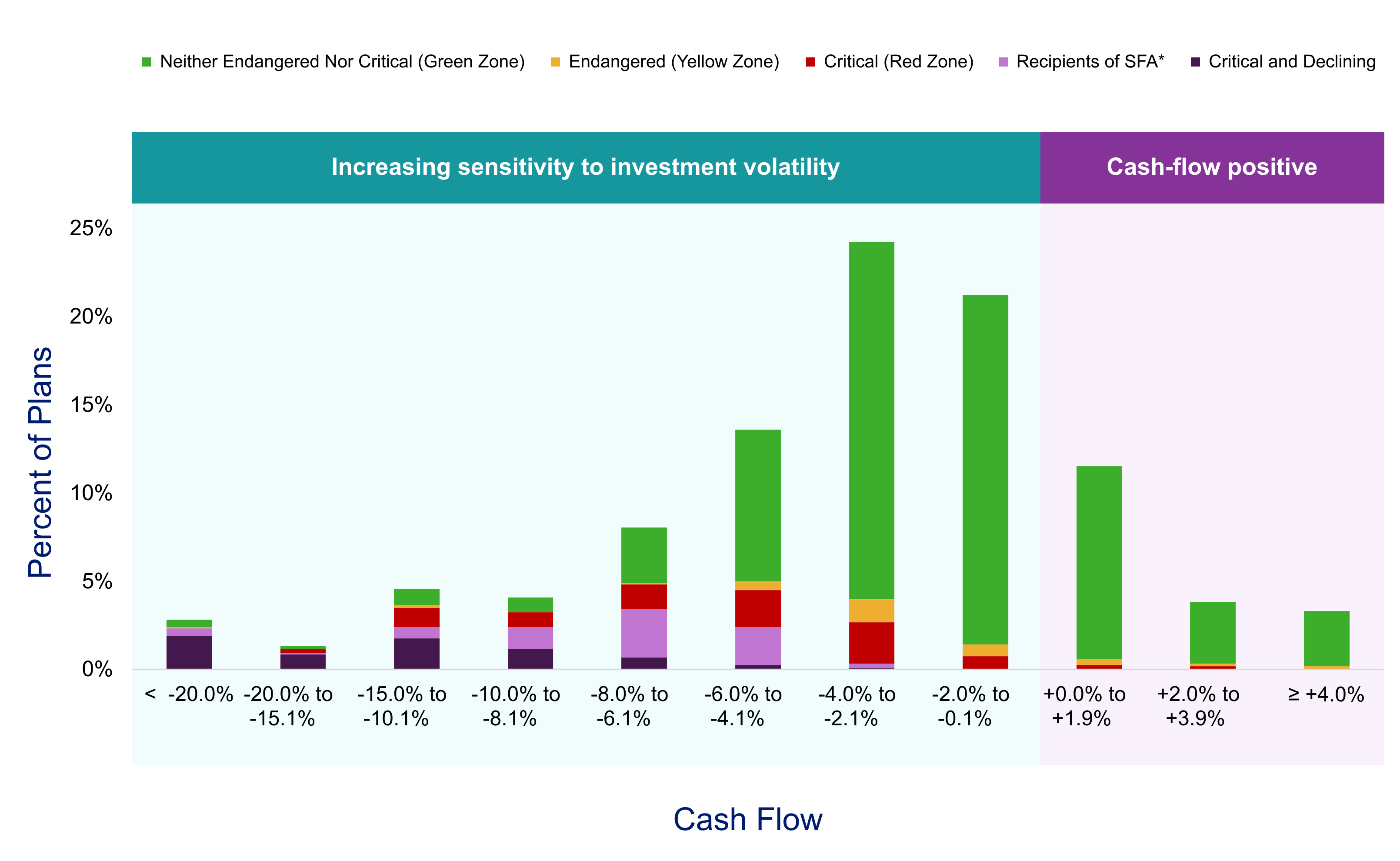
* SFA stands for “Special Financial Assistance” from the Pension Benefit Guaranty Corporation (PBGC) authorized by the American Rescue Plan. It is important to keep in mind that most plans in critical and declining status shown in the graphic above have applied for SFA. Once a plan receives SFA, its assets will increase, and its net negative cash flow as a percentage of assets will improve.
Source: Segal analysis of Form 5500 data for multiemployer plan years ending in 2024. Zone status applies to plan years ending in 2025. SFA awards are as of December 31, 2025.
Although the graph focuses on multiemployer plans, sponsors of public sector plans and corporate plans may also be interested in exploring the risk-mitigation strategies described below.
While every plan is different, we find that plans with net negative cash flows that exceed an increasing percentage of assets tend to find value in de-risking strategies.
There are four primary ways that plan sponsors can approach de-risking:
Over the past few years, plan sponsors that have evaluated these strategies have learned that there is no universal “best” approach for reducing risk. For example, a multiemployer plan that recently received SFA has different objectives from a green-zone plan that is 115 percent funded, which, in turn, has different objectives from a plan that has just entered the red zone.
The demographic maturity, cash flows, current and projected funded percentages, and strength of the contribution base all matter — and they interact in ways that intuition alone cannot capture. It’s important to note that each of these de-risking strategies is easier to implement in higher interest rate environments.
To learn more about de-risking strategies, watch the recording of our webinar, “Benefit‑Driven Investing Strategies and How They Can Reduce Risk.”
Once the plan sponsor has defined its funding objectives, an ALM study can help define risk tolerance and inform the investment strategy.
At a minimum, a simple ALM study can help educate a plan sponsor on the range of possible funding outcomes given the investment portfolio’s expected return and volatility.
More involved ALM studies can help plan sponsors make important funding and investment decisions such as:
It is important for the plan sponsor to coordinate with both its investment consultant and actuary on any ALM study and de-risking strategy.
Let’s have a conversation.
Get in Touch


This page is for informational purposes only and does not constitute legal, tax or investment advice. You are encouraged to discuss the issues raised here with your legal, tax and other advisors before determining how the issues apply to your specific situations.