
Articles | November 5, 2026
Our latest short quarterly insight for sponsors of group health plans focuses on how federal Transparency in Coverage (TiC) rule has fundamentally changed healthcare pricing analysis. It presents some illuminating statistics for selected services in one city and describes how health plan sponsors can use healthcare price transparency data.
It also covers the recent TiC final rule to designed to improve the accuracy, accessibility and usability of healthcare pricing data.
The cost of health services can vary dramatically within a geographic region, as illustrated by the sample comparison below of selected health services provided by four carriers in one city. Moreover, the insurer with the lowest and highest costs varies by service.
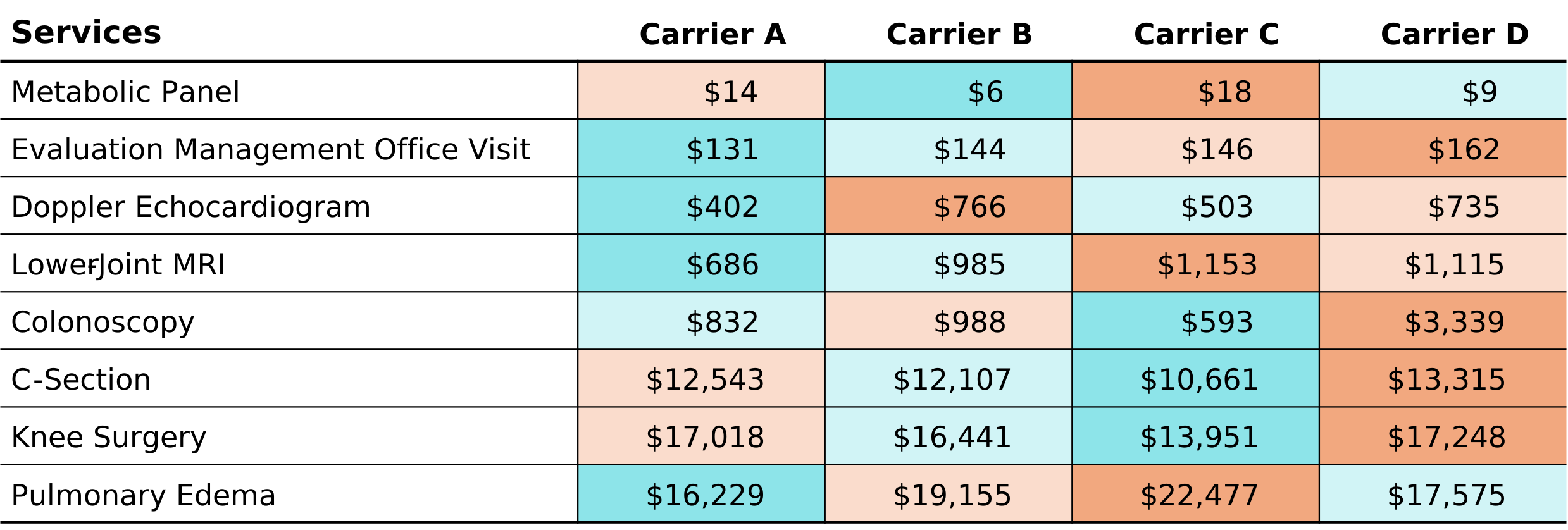
Note: The colors represent relative cost, with orange indicating higher-cost services and teal indicating lower-cost services.
Source: Segal’s Analysis of Medical Provider Pricing (AMPP), powered by Green Light.
Health plan sponsors continue to face mounting pressure from rising healthcare costs. Medical trends are approaching historic highs, driven by provider price inflation, hospital consolidation, increased utilization and growing reimbursement complexity. Provider networks are constantly evolving as health systems acquire competitors, expand into new markets, recruit providers and renegotiate contracts. In some markets, favorable out-of-network reimbursement and independent dispute resolution (IDR) outcomes have created incentives for providers to leave network arrangements and pursue higher reimbursement outside of contracted rates. As a result, a network that delivered competitive value just a few years ago may no longer represent the most cost-effective option today.
The federal TiC rule has fundamentally changed healthcare pricing analysis by providing unprecedented visibility into negotiated provider reimbursement rates. Previously, confidentiality restrictions and the opaque nature of provider contracting limited plan sponsors’ ability to evaluate and benchmark network pricing. Today, plan sponsors and their advisors can compare network pricing across competing offerings, identify variation in reimbursement rates for the same services, assess provider contract competitiveness and validate whether a network is delivering the value expected.
While multiple factors influence carrier selection and performance evaluations, including service quality, administration and clinical support, provider reimbursement levels typically have the greatest impact on overall healthcare costs. Consequently, validating network competitiveness has become both a prudent fiduciary practice and an increasingly important component of a comprehensive cost-management strategy.
Currently, TiC data does not contain claims utilization data. Segal’s Analysis of Medical Provider Pricing (AMPP), developed in partnership with Green Light, helps plan sponsors efficiently combine TiC data with a plan’s claims experience and Medicare benchmarking.
These analytics can support the following initiatives:
TiC data offers significant insight into provider pricing, but it is not without limitations. The data may contain duplicate records, “ghost rates” for services that are rarely performed and contract-specific pricing arrangements that can distort comparisons. Meaningful interpretation requires actuarial judgment and contracting expertise to account for utilization, provider mix, geographic variation and contract nuances.
When combined with claims analytics, Medicare benchmarking and experienced interpretation, TiC data can provide plan sponsors with a powerful tool to evaluate network value, strengthen fiduciary oversight and make more informed healthcare purchasing decisions.
The Departments of Labor, Health and Human Services, and the Treasury recently finalized updates to the TiC regulations designed to improve the accuracy, accessibility and usability of healthcare pricing data. Key changes include revised machine-readable file requirements, quarterly rather than monthly reporting, formal attestations regarding data accuracy and completeness, expanded consumer access to cost information by phone and future prescription drug transparency reporting.
For plan sponsors, these enhancements can provide more reliable data to evaluate network competitiveness, benchmark provider reimbursement, strengthen fiduciary oversight and identify cost-management opportunities. Beginning in 2027, as the new requirements are phased in plan sponsors should work with their insurers, third-party administrators and advisors need to understand compliance obligations and explore how enhanced transparency data can support network, procurement and healthcare purchasing strategies. To learn more about the final rule, see our October 19, 2026 insight, “Final Rule on Healthcare Transparency in Coverage.”
Contact your Segal consultant or get in touch with us.


This page is for informational purposes only and does not constitute legal, tax or investment advice. You are encouraged to discuss the issues raised here with your legal, tax and other advisors before determining how the issues apply to your specific situations.
