Articles | April 23, 2026
Our latest short quarterly insight for sponsors of group health plans focuses on leveraging artificial intelligence (AI) to improve healthcare cost and outcomes.
It covers:
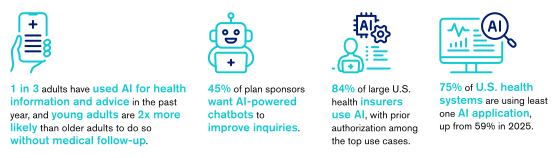
AI is becoming embedded across the health benefits ecosystem, with significant implications for plan sponsors. AI tools are reshaping how participants engage with their health, how claims are processed and how vendors manage utilization and payment. Used thoughtfully, AI can improve participants’ experience, increase engagement in underutilized programs and support cost control. Used without appropriate governance, it risks accelerating cost growth by protecting intermediary margins rather than delivering savings to plan sponsors and participants.
One of AI’s most promising applications for plan sponsors is personalized health communication. Plan sponsors no longer need an authenticated, data-driven platform to provide relevant and personal information and guidance. Users can simply share what they want to share about themselves and their needs, and an AI tool will guide them intuitively (through simple questions and answers, in their preferred language, at their level of benefits literacy) to find or choose what’s right for them. This increases the user’s control and agency in deciding how their personal information is used by the plan sponsor, which in turn helps build trust and engagement.
Personalized messaging can improve awareness of preventive services, guide participants to appropriate care settings and encourage use of sponsored programs, such as care management, mental health support and condition-specific interventions. Improving engagement in programs that are already funded but underutilized can enhance the return on investment.
Participants are increasingly using AI themselves to navigate the healthcare system. Many rely on AI tools to interpret lab results, imaging reports and other clinical information that can be difficult to understand. Others use AI to organize questions, summarize recent test results and prepare for physician visits. When used appropriately, these tools can help participants arrive better informed, support more productive clinical conversations and improve adherence to care plans. For plan sponsors, this trend underscores the importance of ensuring that participant-facing AI tools are aligned with evidence-based guidance and clearly positioned as supplements to — not substitutes for — clinical judgment.
A growing group of vendors combines AI-driven navigation, primary care-centered models and clinician-supported guidance. These approaches support plan sponsor objectives such as steering participants to high-value care, improving primary care utilization, reducing avoidable emergency and specialty spending, and increasing benefit understanding without relying solely on higher deductibles or narrow networks.
Predictive analytics can reveal emerging patterns across a covered population, enabling earlier outreach and care management before conditions escalate into high-cost claims. Earlier intervention can improve outcomes and help moderate long-term cost trends, particularly for chronic and progressive conditions. These benefits are anticipated to be realized when AI insights are paired with human review and clear clinical pathways.
AI has the potential to improve claims processing efficiency and payment accuracy. Automation can reduce processing time and the administrative burden, while advanced analytics can help identify anomalous billing patterns and potential fraud. For self-funded plans, these capabilities may support stronger payment integrity and lower administrative costs. However, automation alone does not guarantee savings. Without transparency into how AI models operate and how decisions are reviewed, automation can just as easily accelerate overpayment as prevent it.
The risk becomes more pronounced when AI is deployed by intermediaries whose incentives are misaligned with plan sponsors. Hospitals are increasingly using AI-powered ambient listening and clinical documentation tools that convert clinician-patient conversations, labs and notes into highly detailed medical records. A March 2026 Blue Cross Blue Shield Association/Blue Health Intelligence study found that expanded documentation often captures additional diagnoses or comorbidities without corresponding changes in treatment, making patients appear more clinically complex on paper. As a result, approximately 20 percent of inpatient cost growth (within a 9 percent overall increase) was driven by coding intensity rather than more care delivered.
Plan sponsors can harness AI to improve participant experience, increase engagement and support earlier, more effective care — while maintaining strong oversight. With intentional design and governance, AI can help plans manage costs and improve outcomes. Without it, AI risks becoming another driver of healthcare inflation — more sophisticated in execution, but no less misaligned with plan sponsor objectives.
Key strategies include:
AI is changing much more than healthcare. Generative AI is an extremely powerful tool for improving operational efficiency, including how work is performed, how participants access information about their employee benefits and how plans are administered.
AI’s potential to accelerate positive transformation depends on encouraging your people to embrace the technology. That’s why we developed a framework for navigating AI integration that’s based on a human-first approach.
Whatever your organization’s level of AI integration, we have resources to help you navigate the journey and mitigate risks, including these:
See all of our insights on AI.
Contact your Segal consultant or get in touch with us.


This page is for informational purposes only and does not constitute legal, tax or investment advice. You are encouraged to discuss the issues raised here with your legal, tax and other advisors before determining how the issues apply to your specific situations.