
Articles | September 28, 2026
This multiemployer pension plan news recap covers:
Our latest survey of calendar-year multiemployer plans found that more than three-quarters are in the green zone for 2026. When plans that have received Special Financial Assistance (SFA) are included, there are more well-funded plans now than in 2008, when the first zone-status certifications under the Pension Protection Act were created. The graph below shows the percentage of calendar-year plans in each zone for select years, according to our annual survey.
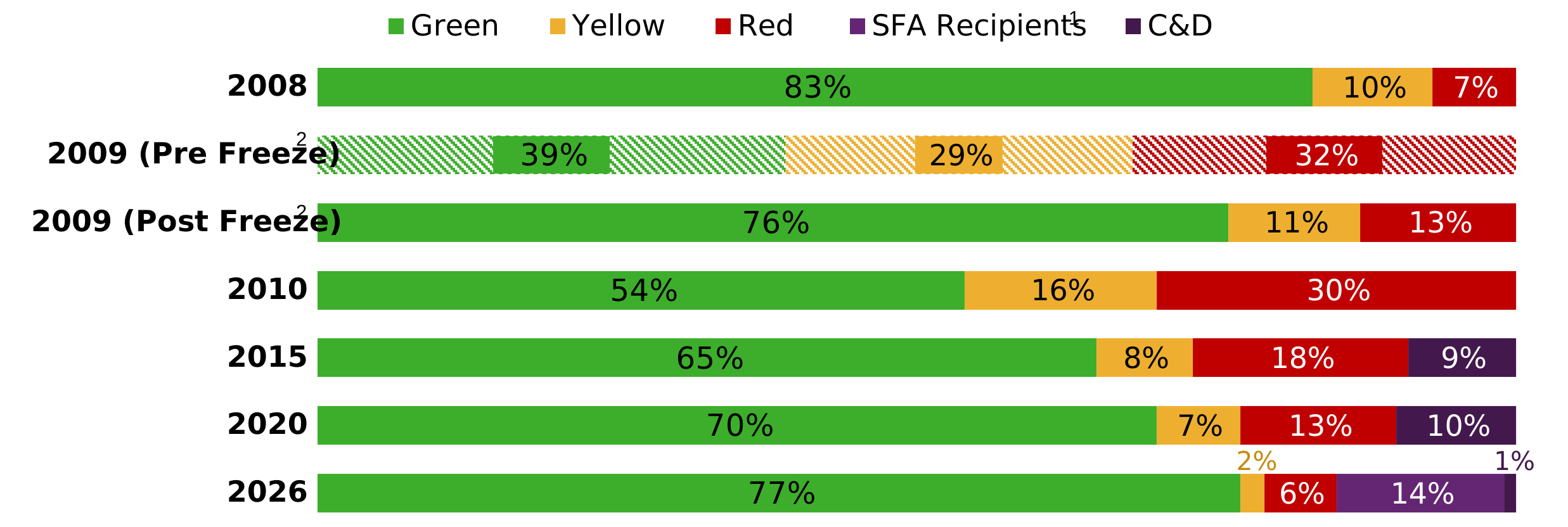
1 SFA recipient plans are deemed to be in critical status through 2051.
2 The 2009 data is split before and after any election to freeze zone status for 2009, as allowed by the Worker, Retiree, and Employer Recovery Act of 2008.
To see more key findings from our latest survey, download our 2026 Survey of Plans’ Zone Status report.
Kevin Warsh, who became chair of the Federal Reserve (the Fed) on May 11, 2026, is the fifth person in that role over the past 40 years. He has introduced changes to reduce Fed communications on future interest rate trends and has declined to submit his “dot plot” of interest rate projections. Warsh believes that markets will perform better responding to real economic data as opposed to interpreting Fed rate actions.
On June 17, 2026, Warsh announced the formation of five task forces to prepare monetary policies that are focused on communications, balance sheet policy, data integrity and sourcing, productivity and job growth, and inflation drivers. He has been a vocal critic of relying on quantitative easing during emergencies. Warsh has also stated that controlling inflation is the priority.
Although Warsh may implement some cultural changes at the Fed, interest rate decisions are still made by a majority vote of the 12-member Federal Open Market Committee (FOMC).
Investors are watching the Fed’s interest rate policy decisions in an environment where inflation and affordability are paramount. August’s headline consumer price index (CPI) rose at a monthly rate of 0.4 percent (3.4 percent annualized). On September 16, 2026, the Fed voted unanimously to increase the Fed funds benchmark rate by 25 basis points, to a new range of 3.75 percent and 4.00 percent. Fed chair Warsh said, “inflation is too high and has been for too long.” This is the Fed’s first rate rise since July 2023.
AI can be a useful tool for plan sponsors by summarizing plan documents, drafting participant communications and facilitating data collection and analysis. The following are three guiding principles when setting up an AI policy for organization use:
All communications and disclosures generated by AI require human review.
Learn more about this strategy in our article.
Understanding participant needs for retirement is challenging. Data can be used to assess retirement readiness and reveal gaps as well as to provide insight into plan design and financial wellness strategies. These strategies include more effective targeted communication to improve retirement plan participation, savings behavior and outcomes.
To learn more about these strategies, watch the recording of our July 15, 2026, webinar on retirement readiness.
In recent years, several pension plans have faced lawsuits regarding whether the factors used to convert benefits to optional forms of payment are actually “actuarially equivalent.” The lawsuits focused on outdated mortality tables and interest rate assumptions that resulted in lower benefits.
In 2026, both the 6th and 11th Circuit Appellate Courts agreed that actuarial assumptions used must be reasonable, but neither defined the word “reasonable” or determined whether the challenged assumptions were reasonable.
The 6th Circuit case is Thomas Reichert v. Kellogg Co. The 11th Circuit case is Drummond v. Southern Company Services, Inc.
Speak to your Segal consultant or
Contact Us


This page is for informational purposes only and does not constitute legal, tax or investment advice. You are encouraged to discuss the issues raised here with your legal, tax and other advisors before determining how the issues apply to your specific situations.
