
Reports and Surveys | July 23, 2026
In late spring and summer 2026, we surveyed managed care organizations, health insurers, PBMs and TPAs about their projected 2027 trends for medical, prescription drug, dental and vision coverage. We found some projected health plan cost trends are approaching 15-year highs.
The respondents to the 2027 Segal Health Plan Cost Trend Survey — our 30th annual survey of trend projections — represent a substantial portion of the commercial insured and self-insured markets.
The projections they shared with us are invaluable as you plan your organization’s 2027 healthcare coverage, since cost trend assumptions are one element that underwriters and actuaries use to project future costs for plan sponsors. You can also use trend projections to challenge vendor rate renewals.

Request your copy of the 2027 Segal Health Plan Cost Trend Survey to learn key findings about trend projections and cost drivers, including:

It is important to view medical trend projections within the context of a highly dynamic and evolving environment. Projecting future costs is challenging given the influence of macroeconomic uncertainty, regulatory changes and shifting market dynamics, including provider consolidation, emerging technologies and evolving reimbursement models.
In recent years, these factors have introduced greater volatility into trend performance. As a result, projections do not always align with actual plan experience. Historically, underwriters and actuaries have tended to project conservatively; however, the increasing complexity and pace of change in the healthcare environment have made actual results more variable, with outcomes deviating in either direction depending on how these factors materialize within a given plan year.
To assess the accuracy of trend projections, we compared 2025 projected trends for medical, Rx and dental plans from a prior survey to the actual average trends for 2025 (the most recent period for which actual data is available), as reported by the survey respondents.
The survey report also includes actual 2025 trend data from Segal’s health data warehouse, SHAPE (Segal’s Health Analysis of Plan Experience) on:
Survey respondents were asked to rate cost-management strategies plan sponsors are using or plan on implementing in 2026 for both medical and pharmacy benefits. The report shows the top five strategies for managing the cost of medical benefits — including two strategies that are tied for fifth place — and the top five pharmacy strategies for managing the cost of pharmacy benefits.
Most of these cost-management strategies will still be relevant for 2027 — and beyond.
The survey report outlines strategies plan sponsors can use to monitor and manage cost trends over time. We recommend a balanced, three-pronged approach to effective healthcare cost management. It involves managing plan design/networks, vendors and population health.
Data analytics are central to supporting each of those cost-management strategies. In today’s high-trend environment, ongoing claims monitoring is critical for revealing emerging cost drivers.
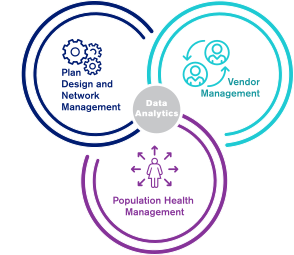
The report highlights practical strategies to track, manage and mitigate rising healthcare costs over time.
Complete the short form at the top of the page to get your copy of the report.
Health plan cost trend is the measure of changes in allowed per capita claims cost. Allowed per capita claims cost is eligible billed charges (before participant cost sharing) less provider discounts.
Multiple factors influence trend, including new treatments, therapies and technologies, medical price inflation, increased treatment burden due to the aging population and rise in chronic conditions, provider consolidation, provider cost shifting from reduced payment by Medicare and Medicaid, and billing practices driven by artificial intelligence, which allowing more precise coding.
Although there is usually a high correlation between a trend rate and the actual cost increase assessed by a carrier, trend and the net annual change in plan costs are not the same. A plan sponsor’s costs can be significantly different from projected claims cost trends.


This page is for informational purposes only and does not constitute legal, tax or investment advice. You are encouraged to discuss the issues raised here with your legal, tax and other advisors before determining how the issues apply to your specific situations.