
Articles | November 16, 2026
Artificial intelligence (AI) is lowering the cost and increasing the quality of forged documents and impersonation. Rapid advances in generative AI have made it easy to create new, highly realistic, fake content that looks and/or sounds authentic.
Cybercriminals are taking advantage of the technology to develop convincing synthetic identities and deepfakes that are designed to steal information. These capabilities are becoming more accessible and scalable, increasing the risk that fraud attempts will target business processes.
As with more traditional cyberattacks, certain organizations are more likely than others to be targets of synthetic identity and deepfake fraud. Specifically, at-risk organizations include those that process benefits or payments; validate identities or eligibility and/or rely on submitted documentation. For sponsors of employee benefit plans, the risk may surface in everyday administrative processes, including distribution requests, account changes and eligibility verification.
This article describes synthetic identities and outlines what plan sponsors can do now to reduce their risk of falling victim to synthetic identity fraud. It includes a deepfake defense checklist.
Synthetic identities are sophisticated and convincing simulated “people.” Typically, they are created using a combination of real stolen data, such as a Social Security number, and fabricated data.
Cybercriminals create fake IDs for each synthetic identity. They also use AI to generate static and video images of the synthetic identity and audio of a voice.
Additionally, cybercriminals are using generative AI to develop visual and/or voice-cloning audio deepfakes that impersonate real people, including co-workers and trusted leaders. For example, a cybercriminal could combine stolen participant information with an AI-generated identification document and a cloned voice to request a distribution or change payment instructions.
AI-enabled automation can also make it easier for cybercriminals to create fraudulent identities and deepfakes at scale, increasing the speed and potential reach of attacks. This approach accelerates the pace of attacks and raises risk for vulnerable organizations.
Synthetic identities and deepfakes make fraud attempts appear more legitimate and harder to detect. They also make it easier for cybercriminals to bypass identity verification processes.
In contrast with another serious AI-related threat — AI models that can identify and be directed to exploit vulnerabilities across major operating systems and applications — the threat presented by synthetic identities and deepfakes is not purely an IT or cybersecurity issue. It’s an operational issue.
Consequently, vulnerable organizations must review their operations to identify weaknesses so they can be addressed promptly. Identify the processes that are most vulnerable to convincing fake documentation.
Importantly, no single tool or control — human or technical — is sufficient to mitigate the risk. Controls must combine technology, process and human validation. Human judgment alone, which becomes less reliable under pressure, is not an adequate defense.
Effective defense against fraud related to synthetic identities and deepfakes requires multiple, independent layers of administrative and technical controls, where failure in one layer is caught by another.
To protect themselves, organizations should at a minimum:
Consider following this checklist below, which is organized by nine control layers:
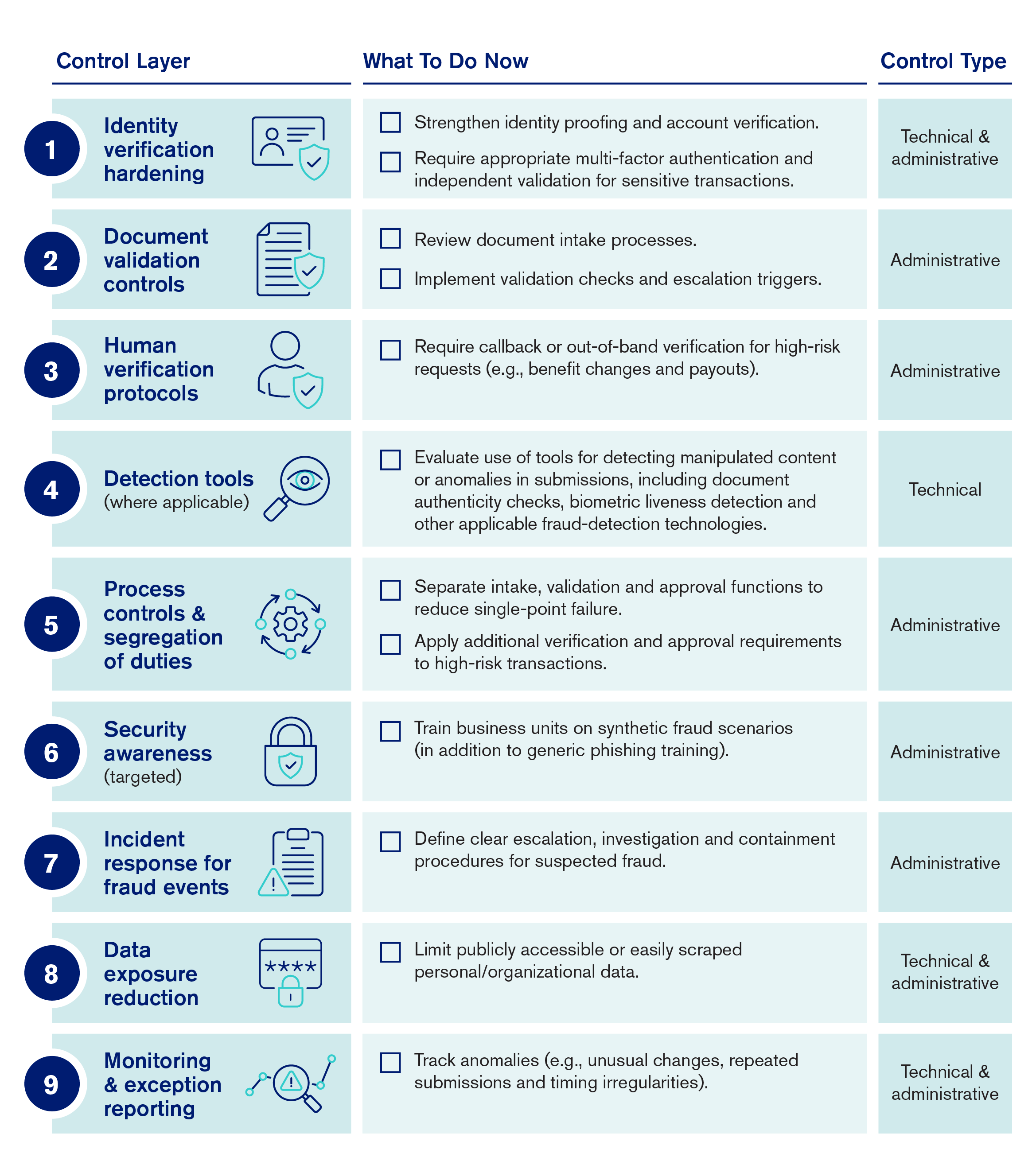
Source: Segal
Download this ChecklistThis is the same defense-in-depth principle long used in cybersecurity, applied to fraud and identity risk.
For plan sponsors that rely on third-party administrators, recordkeepers or other service providers, an important step is understanding which controls those providers perform and how their effectiveness is evaluated. Sponsors should consider asking providers how they verify identities, authenticate sensitive requests, detect potential fraud and escalate suspicious transactions.
Plan sponsors do not need to address every process at once. Consider starting by identifying the transactions that could produce the greatest harm. Then, determine where identity is verified and document which party performs each control.
Perfection is not the goal. Instead, aim for independent controls that fail differently.
Each control layer will have gaps. Risk occurs when the gaps align across layers.
Given the dramatic evolution of generative AI, oversight and remediation should be an ongoing process.
AI-generated content increases the risk of convincing fraud and identity manipulation. Plan sponsors are tempting targets because they hold sensitive and confidential data.
The immediate priority is to identify the transactions that are most vulnerable to impersonation or fabricated documentation. Plans that rely on single-point verification are most exposed.
For plans subject to ERISA, cybersecurity and the protection of plan data and assets is part of prudent plan governance.
The best defense is a layered control model that combines technical, procedural and human safeguards. Plan sponsors that implement overlapping controls will be best prepared to defend themselves from this serious threat to security.
As generative AI evolves, these controls should be tested and updated regularly.
Talk with us about reviewing your plan’s identity-verification, transaction-approval and fraud-response processes.
Get in Touch


This page is for informational purposes only and does not constitute legal, tax or investment advice. You are encouraged to discuss the issues raised here with your legal, tax and other advisors before determining how the issues apply to your specific situations.
